
Parametric Input, Natural Language Input, Model Context Protocol Connected Artificial Intelligence to CATIA
- Stephen Sharma

- Jun 15
- 4 min read
There is a persistent, frustrating gap between design and reality. Today, a General Physics Corporation engineer dreams up a concept, drafts it in a CAD (CATIA, SpaceClaim) suite, hands it off to a simulation team for finite element analysis, tweaks it, tosses it over the wall to manufacturing techs, who then write G-code, set up jigs, and manually prep the CNC machines. Every handoff is a friction point. Every translation layer is a vulnerability.
At General Physics, we view this fragmentation as an optimization problem. We are proud to announce a deep, multi-disciplinary co-development initiative with Dassault Systèmes and FANUC to permanently close this loop.
Our goal is nothing less than the absolute automation of design, simulation, and physical manufacturing for everything from advanced scientific hardware and luxury maritime vessels (nuclear fusion propulsion) to consumer goods made with recycled material. Here is how we are building the unified pipeline from a single parametric string to a finished, robotically machined part.
The user experience begins deceptively simply within the CATIA UI: a natural language dropdown menu powered by a specialized Large Language Model (LLM). But underneath this interface lies a deeply integrated technical stack.
[Natural Language Input] (LLM based concept)
          │
          ▼
[Parametric Input String + Metadata Tracker] (new calculus with Riemann zeta integration)
          │
          ▼[
Physics-Informed Neural Networks (PINNs)] ──> [Discretized PDEs/ODEs]
          │
          ▼
[Model Context Protocol (MCP)]
          │
          ▼
[CATIA Design & Simulation Environment]
When an engineer selects a design intent, the system generates a Parametric Input String coupled with an immutable Metadata Tracker. This string feeds basically into our Model Context Protocol (MCP), which serves as the translation layer between natural language constraints and the rigorous underlying physics.
Rather than relying on traditional, computationally expensive mesh generation and iterative solvers, the MCP passes these parametric constraints directly from a custom Physics-Informed Neural Network (PINN). Again, we are approaching the A.I. with a PINN base and ML through mathematical convolutions.
Backed by the Universal Approximation Theorem, which guarantees that a neural network can represent any continuous function to arbitrary precision, our PINNs are constructed as a weighted functional form of governing partial and ordinary differential equations (PDEs/ODEs).
When the design space shifts, the calculus shifts dynamically. The network natively solves for extreme design and simulation environment problems in real-time, including:
1) Thermal & Structural Dynamics: Heat flux maps, stress-strain tensors, and microcracking propagation.
2) Extreme Environments: Neutron flux discretization, flux integral evaluations, and long-term neutron embrittlement analysis—critical for our core nuclear and fusion architectures.
Deterministic A.I. systems often suffer from "slop"—homogenized, repetitive, or structurally unstable outputs that fail when exposed to real-world chaos. To counteract this, General Physics is introducing an entirely new mathematical mapping layer. Our PINN outputs are mapped using a custom prime number correlation function that transforms the network’s raw weights into distinct Fourier patterns. This ensures high-fidelity, non-repeating structural variance that adheres to deep mathematical principles rather than probabilistic guesswork. Looking forward, this pipeline is built with cloud-connected hooks into eventual Quantum Q# algorithms. By utilizing elliptic functions and quantum-state matrix representations, we shall soon scale our plasma and structural simulations beyond the limits of classical silicon, preparing our manufacturing pipeline for true emergent, General A.I. capabilities.
Our neural architectures mimic biological systems by employing lateral inhibition functions. By silencing sub-optimal node pathways while amplifying dominant, structurally sound solutions, the design environment exhibits emergent problem-solving behaviors. The software doesn't just calculate; it discovers optimized geometries that an engineer might never think to draft manually.
Automating the pipeline from cloud-based quantum code to a multi-axis CNC mill requires ironclad security. A single corrupted file or hijacked parameter could destroy a multi-million-dollar manufacturing cell or compromise proprietary nuclear topologies.
Our architecture implements a robust file-saving and memory-flagging cybersecurity protocol explicitly mapped to MITRE ATT&CK and D3FEND codes. Every transition—from the PINN to the MCP, and from the MCP to CATIA—is cryptographically verified. If a parameter falls outside a strictly defined physical boundary or displays an anomalous metadata signature, the system immediately flags the memory address, isolates the process, and halts execution before code ever reaches a factory floor.
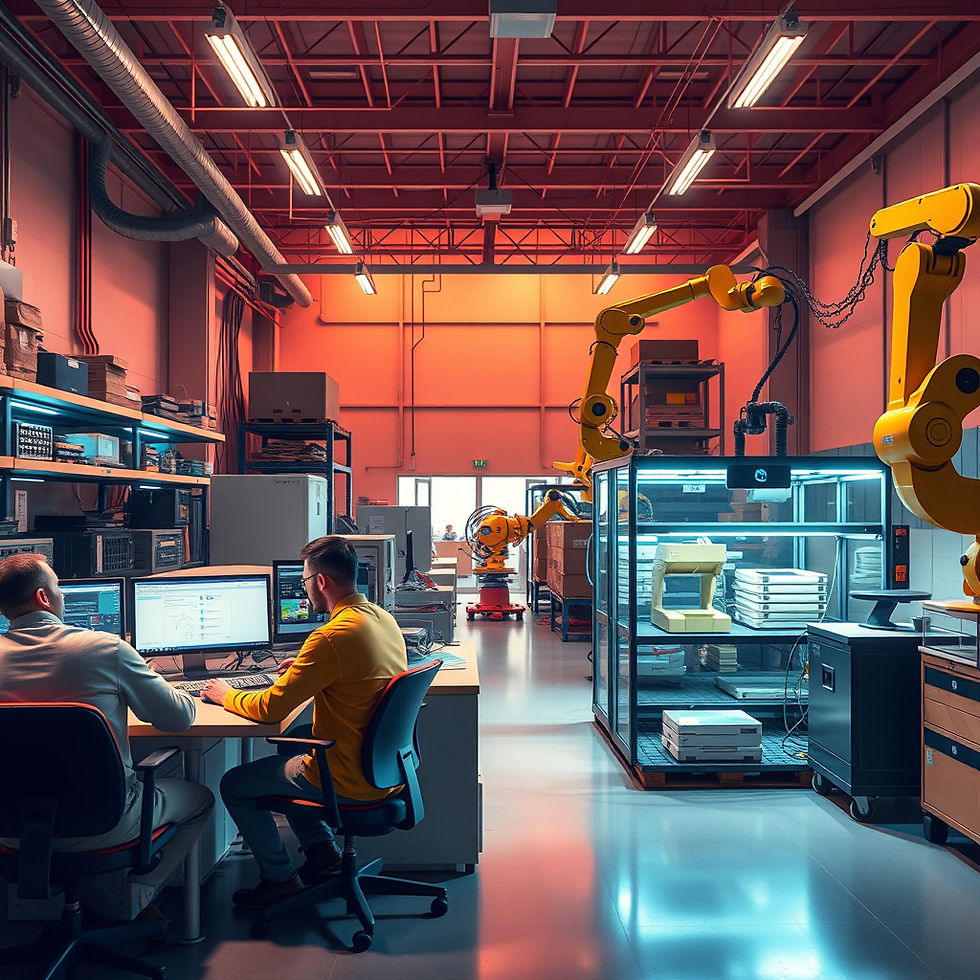
The most brilliant cloud-based simulation is useless without a machine that can cut metal. This is where FANUC’s unparalleled automation expertise comes in. The output of our PINN-backed CATIA environment updates directly to raw, optimized CNC G-code that drives physical assets seamlessly.
As any manufacturing engineer knows, the devil is in the details. True automation isn't just about spinning a lathe; it’s about the messy, physical maintenance tasks that keep a factory running.
Our joint workflow deploys advanced robotics to solve the gritty, real-world problems:
1) Surface Preparation: Robotic arms precisely apply mold release agents to complex shapes and molds.
2) Material Handling: Automated systems install jigs, securely tighten component and assembly bolts to cutting tables, and smoothly transfer heavy workpieces between CNC mills, lathes, and routers.
3) Hybrid Manufacturing: Connecting traditional subtractive CNC machining directly with large-scale additive manufacturing and automated press brakes.
Our goal is nothing less than the absolute automation of design, simulation, and physical manufacturing for everything from advanced scientific hardware and luxury maritime vessels to consumer goods. Here is how we are building the unified pipeline from a single parametric string to a finished, robotically machined part.
[Optimized G-Code] ──> [FANUC Robotic Arms] ──> [Apply Mold Release / Setup Jigs]
                                                         │
                                                         ▼
                                            [CNC Mill / Lathe / Press Brake, 3D Printer]
                                                         │
                                                         ▼
                                            [Finished Assembly]
The scalability of this automated framework is staggering. On the micro-scale, we are utilizing miniaturized electrodeposition and chemical etching to manufacture micron-scale Neutral Beam Injection (micronNBI) components, allowing us to scale down the physical footprint of fusion power plants while increasing efficiency. On the macro-scale, this same software-to-hardware pipeline scales up to massive, crane-like robotic arms designed for heavy marine engineering. By deploying this automated architecture in larger shipyards, we aim to accelerate the production of next-generation vessels—enabling a 10,000x production scale-up of advanced fusion-powered ships and luxury yachts.
This collaboration between General Physics, Dassault Systèmes, and FANUC isn't just an incremental improvement in CAD/CAM software. It is a fundamental paradigm shift. By linking natural language inputs directly to the fundamental equations of physics, securing it with world-class cryptography, and executing it via cutting-edge robotics, we are building the foundation for autonomous industrial evolution. We are removing the human bottleneck from the middle of the design-to-manufacturing loop, leaving minds free to focus entirely on what to build next. This is just one of many ideas we are bringing to life. Stay tuned.


Comments